Studio writing October
A collecting of October thoughts and ideas.
There are moments in the studio when language fails not out of lack, but excess. The world speaks in rhythms too deep for grammar, in shimmer and silence, in the gold swirl behind closed eyes. I’ve come to think of this as the ‘unwritable world’ a terrain of feeling, memory, and myth that resists transcription but demands attention.
In this space, I don’t paint what I see. I paint what leads. The harbinger is my guide not a prophet, but a pulse. A flicker in the periphery. A frisson. A glint of something that arrives before meaning, before image. It’s the moment just before recognition, when the brush moves not toward a subject but through it.
To navigate this world, I’ve had to learn a different kind of listening. Not to words, but to rhythm. Not to form, but to absence. Dyslexia and aphantasia shape this listening. They strip away the expected and leave me with structure, texture, and the felt architecture of thought. I don’t picture the world. I sense its weight. It shimmer. It tilt.
Painting has become a kind of cartography mapping the unwritable through gesture, through felt moments, through the echo of something glimpsed. The harbinger is not the thing itself, but the sign that it's near. A gold blob swirling in the dark. A sudden stillness. A shift in the wind.
This is the language I follow. Not to explain, but to move. Not to name, but to notice.
Frisson as Harbinger, Listening for the Shimmer, Oct 7th
There are moments when the world speaks not in words, but in tremors. A sudden shiver. A breath caught. The skin prickles, the chest lifts, and something ancient stirs. This is frisson. Not just a reaction, but a signal. A harbinger.
I’ve come to understand frisson as one of the many ways I tune into the world’s unwritable language. It’s not a metaphor. It’s a method. A form of deep listening that bypasses logic and lands directly in the body. When I feel it, I know I’m near something an omen, a shimmer, a truth not yet named.
This kind of listening requires a different kind of consciousness. Not the analytical mind, but the emotional field. A porous attention. A willingness to be moved. It’s not passive. It’s devotional. I listen with my skin, my breath, my memory. I look not for form, but for fizz for the moment when the world vibrates just enough to say 'this matters'.
In this way, frisson becomes a compass. It doesn’t tell me what to paint. It tells me where to stand. It leads me toward the edge of the veil, where shimmer lives. Where rhythm and absence coalesce. Where the brush moves not to depict, but to respond.
This is different from the classical muse. She arrives with form. With image. With a guiding hand that whispers, paint this. But frisson doesn’t whisper. It jolts. It doesn’t guide. It ignites. The muse offers vision. Frisson offers voltage.
And perhaps that’s the shift. I no longer wait for the muse. I tune for the tremor. I follow the fizz. I let the omen speak through rhythm, through gold, through the swirl behind closed eyes. I trust that what moves me will move the work. That what shimmers will shape the surface.
Frisson is not inspiration. It’s recognition. A signal from the unwritable world that something is arriving. And my job is not to name it, but to notice.
The Discipline of the Harbinger: On the Martial Art of Improvement, Oct 8th
There’s a rhythm to improvement. Not the loud rhythm of achievement, but the quiet pulse of attention. Each day, I gather knowledge not to accumulate, but to refine. To tune. To sharpen the edge of my practice like a blade drawn across stone.
Improvement, for me, is almost martial. Not in aggression, but in precision. In ritual. In the way a fighter returns to the mat, not to win, but to learn. To feel the shift in weight, the angle of breath, the moment before contact. My studio is a dojo. My brush, a form. My attention, the kata.
This discipline is not about mastery. It’s about readiness. The harbinger doesn’t arrive when I’m perfect. She arrives when I’m listening. When I’ve done the work. When I’ve gathered enough fragments of myth, of shimmer, of frisson to recognize her signal.
Each day, I study. Not just art, but rhythm. Tool maintenance. Buddhist texts. The shimmer behind closed eyes. I gather knowledge like a scout gathers omens not for certainty, but for orientation. To know where I am in the landscape of the unwritable world.
Improvement is not linear. It’s cartographic. I map what I don’t yet understand. I build frameworks to hold the unnameable. I write blog posts not to explain, but to trace the edge of what’s arriving.
This is the martial art of the harbinger. The daily discipline of tuning of preparing the body, the mind, the mythic field. So that when the shimmer comes when the frisson strikes I am ready to move. To respond to paint not what I know, but what I’ve trained to notice.
Crossroads: Looking Down or Walking Out, Oct 10th
Lately, I’ve felt the tug of a crossroads. One path leads downward into the screen, into the scroll, into the curated hum of digital life. The other leads outward into the wind, the mud, the uncurated rhythm of walking.
I catch myself looking down too often. Not in shame, but in habit. The phone becomes a compass, a mirror, a distraction. It offers answers, but not orientation. It fills the silence but doesn’t listen. And I wonder: what am I missing when I choose the glow over the glint of sunlight on wet stone?
There’s a kind of internal listening that I've cultivated through frisson, through myth, through the shimmer behind closed eyes. But lately I’ve realized that this listening needs a landscape. It needs movement. It needs the friction of foot on path, the surprise of a new corner, the echo of birdsong in a place I’ve never stood before.
Walking is not just exercise it’s a method. A way of tuning into the world’s unwritable language. Each step is a question each turn a possibility. The body becomes a sensor, the landscape a text. I don’t walk to arrive. I walk to notice.
Exploring new places, villages, coastlines alleyways reminds me that answers don’t always live inside. Sometimes they live in the way a gate swings open, or how a puddle reflects the sky. Sometimes they live in the rhythm of breath, the ache of the calf, the sudden shift in weather.
So I’m choosing to walk more to look up to let the world speak through texture, through rhythm, through place. The phone will still be there but the path the real one is waiting.
The Gift of Happenstance, Oct 14th
Sometimes inspiration arrives like a gift unwrapped by weather, timing, or the tilt of my gaze. A glint on a puddle. A phrase overheard. A shadow cast just so. It’s not summoned it’s found and only if I’m looking not with my eyes alone, but with my heart open.
I’ve come to trust these moments. They feel like alignment like the world saying yes, now. A corner turned at the right pace. A colour seen in the right light. A thought arriving just as the wind shifts. It’s not planned. It’s tuned.
Could this happen anywhere? I think so. But only if I’m not trying too hard. Only if I’m walking, not chasing. Noticing, not naming. The right eyes aren’t trained, they’re softened. They’re willing to be surprised.
Happenstance is not random. It’s relational. It’s the shimmer that meets me halfway when I’m paying attention. And when it comes, I try to honour it. With a brushstroke. A sentence. A pause.
Because sometimes, the world gives you exactly what you need. You just have to be ready to see it.
A Painted Veil, Oct 16th
I’m searching for a way to evoke form without resorting to its perimeter—to conjure presence without tracing its edge. What I’m after is something more elusive: a felt resonance, a kind of sympathetic vibration between the subject and my own interior rhythm.
It’s not depiction. It’s communion.
There’s a subtle enchantment in this approach—a quiet magic that arises when the brush moves not in obedience to sight, but in response to something deeper. A pulse. A shimmer. A whisper of essence. I want the work to breathe with that kind of knowing. To hold the shape of a thing not through outline, but through attunement.
This is how I try to paint not by looking harder, but by listening better.
The Signal and the Static, Oct 19th
I’m trying to understand modern times, not through headlines or metrics, but through feeling. Through rhythm. Through the way anxiety hums beneath the surface of things. The way digital life flickers but doesn’t shine.
There’s a sweet kind of isolation that comes not from being alone, but from being constantly connected. The scroll seemingly offers shimmer, but never resonance. It fills the space, but doesn’t speak of fulfilment. I find myself reaching for my phone when I should be reaching for the wind, the words from the sea or even just silence.
In my work, I try to tune into the signal beneath the static. To paint not the noise, but the subtle tremor, the frisson and fizz. The shimmer that still speaks from the oldest of moments, even now. Even here.
Modern times feel like a threshold. A place where myth and machine collide.
This is the work. To notice. To resist the flattening. To let anxiety become a signal, not a trap. To let isolation become a question, not a verdict. To paint the shimmer that survives the static.
Glazed Time and Stand Oil, Oct 20th
Glazing mediums are deceptive. They promise control—luminosity, depth, the ability to bend light and layer time. But they demand surrender. You can’t rush a glaze. You can’t force it to dry faster or behave like opaque paint. You have to wait, listen, adjust. You have to walk with it.
In the studio, I’ve been using a mix of stand oil, damar varnish, and turpentine slow-drying, high-shimmer, temperamental. It’s like working with memory. Each layer is a whisper, not a shout. Each pass reveals what was hidden, softens what was harsh. It’s not about power. It’s about presence.
The Brush Becomes a Translator, Oct 24th
Today I painted without knowing what I was painting. Not abstract, not representational, just a rhythm, a pulse, a feeling that refused to name itself. The landscape wasn’t a place. It was a memory. A shimmer. And breath.
There’s a kind of painting that begins not with form, but with feeling. Not with subject, but with sensation. I’ve been chasing that using emotion as a compass, not a destination. The brush becomes a translator, not of words, but of what words can’t hold.
Light is the hardest to name. It’s not yellow or white or warm,- it’s grief, joy, longing. It’s the way a hillside remembers you. The way a window forgives you. I’ve been layering glazes like whispers, trying to catch that moment before language arrives, before the mind interrupts.
There’s no map for this kind of work. Only a willingness to listen. To let the painting speak in its own tongue. Sometimes it’s a smear of ultramarine. Sometimes it’s a silence in the corner. Sometimes it’s a mistake that feels truer than intention.
I think the landscape is inside us. Not as a scene, but as a rhythm. A pulse of belonging. A shimmer of absence. Today, I didn’t paint a place, I painted the feeling of being held by a place. The way light touches you when you’re not looking.
Particles of Shimmer on Absence, Oct 26th
I think the landscape is inside us. Not as a scene, but as a pulse of belonging. A pulse that moves through us on particles of shimmer on absence. Today, I didn’t paint a place. I painted the feeling of being held by a place. The way light touches you when your eyes are closed.
Not as a scene, but as a rhythm.
A pulse of belonging. A shimmer of absence.
A movement through us—on particles of light, on memory, on ache.
Today, I didn’t paint a place.
I painted the feeling of being held by a place.
The way light touches you when your eyes are closed.
The way it forgives you when you’re not looking.
The Last Glaze: Notes from the Coastal Path, Oct 29th
There’s a kind of work that only happens when the season turns. Not the bold strokes of summer, but the quieter gestures those made in the hush between endings and beginnings. I found myself painting again on the coastal path, just as the light began to change. The wind had softened, the tourists had thinned, and the bracken was rusting at the edges.
It’s a vulnerable place to work, not just because of the weather, or the exposure, but because the land itself seems to ask for honesty. The cliffs don’t flatter. The sea doesn’t wait. And the path worn by centuries of feet and forgetting offers no shelter from your own thoughts.
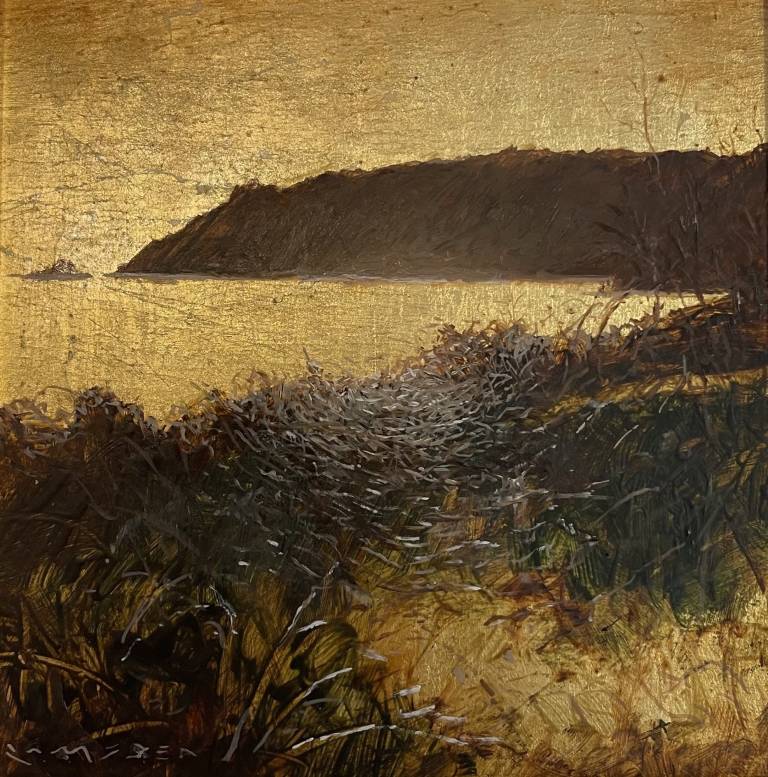
I brought gold leaf with me, not for decoration, but for resonance. There’s something about its shimmer that feels like memory - bright, but fragile. I laid it into the work like a whisper, not a statement, a way of catching the light that was leaving.
Autumn here is beautiful, yes. But it’s also sad. Not mournful, exactly more like a kind of knowing. The kind that comes when you’ve stayed too long in one place, or returned to it after believing you’d moved on. The kind that makes you walk slower, not because you’re tired, but because you want to feel the ground.
I don’t know if they’re finished. Maybe they’re not meant to be. Maybe they’re just thresholds between summer and winter, between bravado and grace. Between the part of me that wants to be seen, and the part that wants to listen.
Byzantine Tradition with Landscape, Oct 30th
I’ve been inspired by religious iconography. Not in the modern sense but in how gold ground is used in religious paintings, especially those featuring Saints or Holy figures surrounded by shimmering gold leaf, which originated in the Byzantine tradition and flourished in Europe from the 13th to 15th centuries, particularly in Italy. These works were designed to evoke divine presence, often viewed in candlelit churches where the gold flickered like sacred light. Russian Orthodox icons seduce the eye, in the way that they shimmer in the dark, and ask to be looked at, not just seen. These works weren’t made for daylight. They were made for candlelight. For silence. For the hush of a church where the gold leaf flickers and the Saints emerge, not in clarity, but in atmosphere.
There’s something deep about that kind of reverence. It's, devotional, in the way gold doesn’t just decorate, it reveals. It catches the light and holds it. It makes the silhouette of the Saint feel both present and unreachable. It’s not about knowing. It’s about longing.
That shimmer has stayed with me.
I’ve tried to make something similar, not with Saints, but with landscape. My spirituality isn’t housed in buildings, it’s scattered across coastlines and bracken and wind. But I still want that flicker. That sense of presence in absence. That way of letting light speak.
So, I’ve been using gold leaf again. Not as ornament, but as invocation. I lay it into the work like a whisper, like a candle lit for something I can’t name. The cliffs become altars. The path becomes a psalm. The shimmer becomes a kind of prayer.
I don’t know if it’s religious, but it feels sacred.
And maybe that’s enough.