November Studio Thoughts
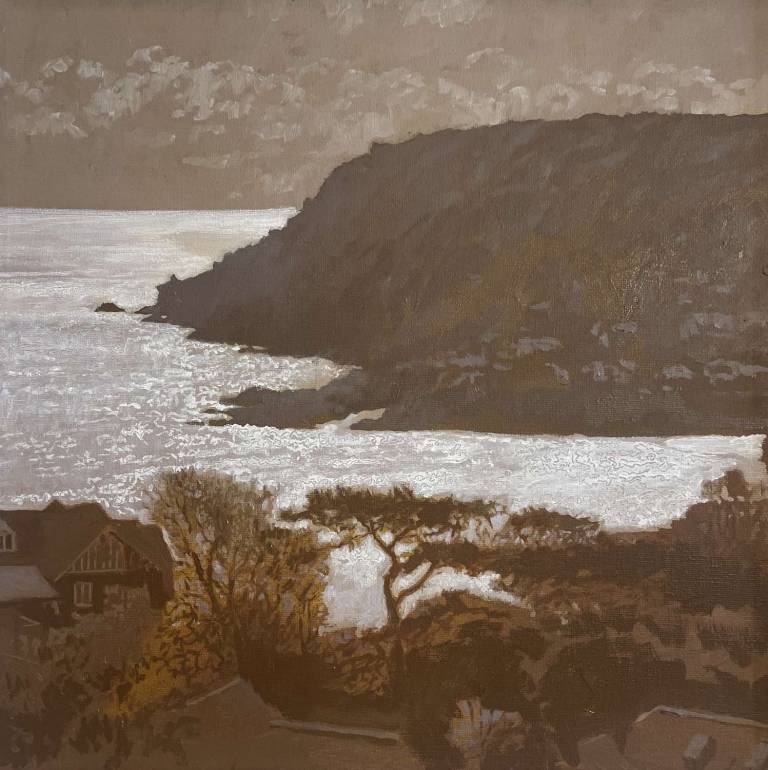
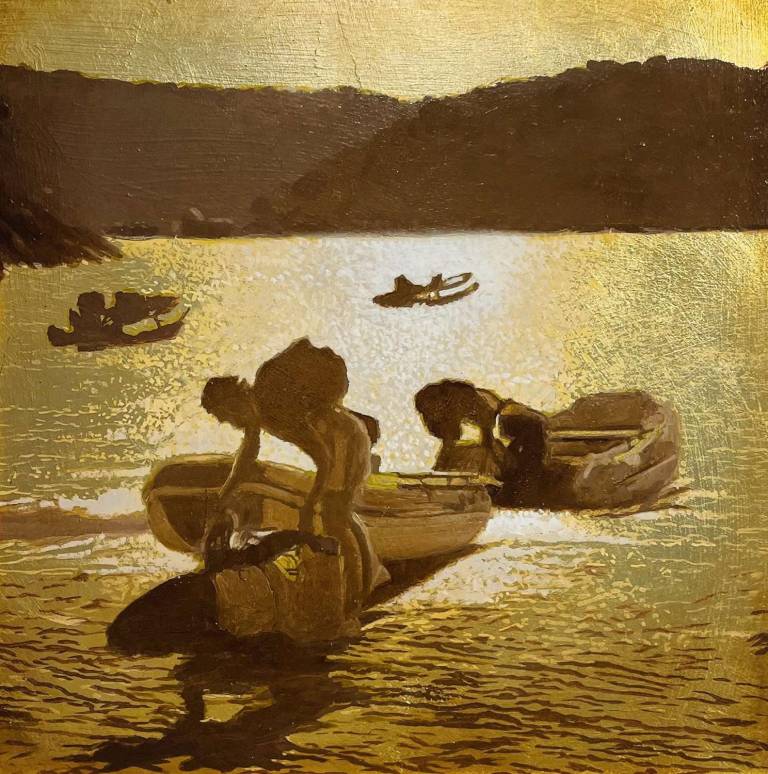
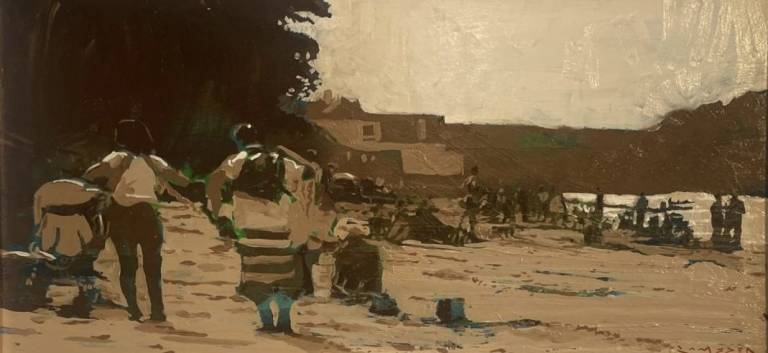

The Camera Doesn’t Feel It, Nov 1st
I took the photo, but it didn’t hold what I saw.
The light was right. The composition worked. The colours were accurate. But the feeling, the shimmer, the ache and the breath of it was gone.
The camera doesn’t feel the wind on your neck. It doesn’t register the hush before a gull cries, or the way gold leaf catches the last of the sun like a held note. It doesn’t know what it meant to stand there, in that moment, with that memory.
Where it saw data, I sees surface. Where the camera saw pixels, I see resonance.
When Something Comes Through, Nov 2nd
There’s a moment in painting when concentration shifts. Not into effort, but into something quieter. I stop thinking about the brush. I stop noticing the time. And the other else begins.
It’s not trance. It’s not flow. It’s more like a collision between focus and surrender. Between intention and listening, I become precise, but porous. The world narrows but also deepens.
When I’m painting at my best, I’m not just applying pigment. I’m translating something. Not an image, but a presence. A memory that almost doesn’t belong to me, but moves through us all unseen.
The canvas becomes a surface for transmission. Not decoration. Not even expression. Something beneath that. Something that wants to be seen, but not fully explained or witnessed.
I don’t always reach that state. But when I do, I know it. The work feels alive. Not finished, but resonant. Like it’s holding something that might speak, if you’re quiet enough to hear it.
Painting as Magnetic Loop, Nov 3rd
When you’re painting especially in that state I've tried to described, where concentration collides with something deeper it’s not a linear act. It’s not input output. It’s circular. The energy you bring to the canvas loops back through you. The pigment becomes a sort of field. The brush becomes a conductor.
No Beginning, no end just as magnetic fields loop, so does the emotional charge of a painting. The shimmer you lay down with gold leaf doesn’t just sit it echoes, returns, reverberates. The viewer’s gaze completes the circuit.
The canvas as closed surface, Gauss’s law speaks of closed surfaces. Transferring that in painting, the canvas is that surface. What ever enters it emotion, memory, rhythm must balance. Nothing escapes. Nothing is wasted. Even the negative space holds charge.
Invisible Fields or Magnetic fields are invisible, yet they shape everything. So too with resonance in painting. The viewer may not see the moment of transmission, but they feel it. The frisson. The shimmer. The loop. Could I think of my painting practice as a kind of field mapping not of magnetism, but of memory, longing, or personal myth. The brush traces invisible lines. The gold leaf catches the flux. The work doesn’t declare it circulates.
White Behind the Eyes, Nov 4th
There are colours that live behind my eyes. They pulse and gather, then dissolve like mist forming briefly into shape before melting away. I sit with them, eyes closed, trying to coax form from flux. Sometimes they glow. Sometimes they flicker. Sometimes they almost gather into narrative.
This is the terrain I’ve been walking lately not of coast or moor, but of mind. A place where vision falters, and imagination lays hidden behind some sort of mind veil. I live with aphantasia: the absence of inner image. My mind’s eye is blind. Yet just before sleep, in that liminal hush, something stirs. A glimmer or fragment. Not summoned, not shaped just arriving just before falling asleep.
I’ve begun to practice in the mornings just after waking, when the world is still and the mind not yet cluttered, I close my eyes and wait. The darkness sometimes turns white. And in that white, objects appear—fully formed, unbidden. I do not call them. They come.
Today, something shifted. I tried not to picture, but to sense. I thought of an object not by its outline, but by its weight, its scent, its texture. I circled the image, rather than entering it. And for a moment briefly I saw something. Not clearly. Not fully. But the beginning of a shape, born from concept rather than sight.
It felt like dreaming with intention. Like mapping a place that resists being mapped.
These are not visions I summon. They arrive. And I’ve learned not to chase them, but to circle them. To think not of how an object looks, but how it feels to think about it and where in my mind the associations are located or generated. It feels like multiple areas of thought are required to form the visual behind my eyes, gathered like clouds, thousands of minutiae swirling together to form a concept or the visual texture of its presence. I conceptualise around the image, not toward it. And in doing so, something shifts. The image begins not as picture, but as some sort of mind echo.
This is not meditation . It is mapping. A slow, deliberate tracing of an inner visual landscape that resists being drawn. But with each practice I hope to expand the field to impart some steadier moments. Then within which I may take that visual silence and ignite a spark in the dark.
Visual imagination, I’m learning, is not a gift bestowed. It is a capacity cultivated. A resonance invited. A form that emerges not from effort, but from attention.
Form from Quite White Eyes, Nov 5th
Remembered canvas
his presence becomes pigment
where absence is traced,
field mapping
vision not speak
silence of parameter walked
the shape around thought
to attend the grasp
imagery in circles
the known pictured
A thing of echo
textures moves into form
chambers mind stirs an image
Lens is now closed
seeing a felt aperture
only shape summoned
with brushes weight arrives
An unbidden pulse of charge
form from quite white eyes
turned in behind dark thoughts
when waking before the hush.
Charged with Seeing, Nov 6th
This morning, I walked to work through the last flare of autumn in their terminal colours, as I’ve come to think of them. The final leaves clinging to their branches with a kind of defiant grace, burnished and bold, as if aware of their own vanishing. They stood like sentinels in the wind, each one a small act of resistance against the coming hush of winter.
As I walked, I found myself thinking not just about the leaves, but about painting. About realism, and where it might go next. Not the realism of surface, but of sensation. Of the things I’ve been writing about here, those energies that lie beneath, around, and just beyond the edge of what can be named. The magnetism of presence. The harbingers of deeper meaning.
How does one paint that?
I’ve begun to wonder if the answer lies not in precision, but in pulse. In brushstrokes that move like wind through bracken. In a palette that shifts away from the safety of Burnt Umber and into something more elemental: raw Sienna, King’s Blue, a touch of magenta to coax purples from the shadows. Not loud colour, but charged colour. Monochrome, mostly. Subtle shifts in chroma that feel like breath, or memory.
I want the paintings to feel immediate. But not obvious. I want them to ask something of the viewer not to look, but to look through. To examine from underneath. To sense what’s held in the silence between strokes.
There’s a kind of realism that doesn’t describe it reveals. That’s what I’m after. The realism of resonance. Of seeing beyond.
In Praise of Slowness A Painter’s Argument Nov, 7th
Slowness is not indulgence it is necessity. In the studio, I’ve begun to notice how rushing sabotages the very clarity I seek. The irony is sharp. I tell myself I don’t have time to do it slowly, yet I somehow expect to have time to redo it later. But the truth is, if I don’t make time to do it right the first time, I’m simply layering urgency over confusion.
This morning, while working, I caught myself sprinting toward the end of a painting, not because it was finished, but because I was eager to begin the next. That next canvas held the promise of new ideas, ones stirred up by the first painting and still fresh in my mind. But in that haste, something muddled. The ideas began to bleed together, overlapping in ways that diluted their power.
Slowness, then, becomes a method of separation. It’s how I gather the ideas that surface during the act of painting and give each one its own space to breathe. It’s how I avoid crowding the canvas with too many voices at once. By slowing down, I allow structure to emerge, intention to clarify, and resonance to deepen.
Painting is not just execution it’s study and study takes time. The time it takes to paint is not separate from the time it takes to understand. To be slow is to honour that process. It’s not a delay; it’s a devotion.
Mantras for Slowness in Painting
“Each mark is a conversation, not a conclusion.”
“Slowness reveals structure; haste hides it.”
“I paint to understand, not to finish.”
Reframes the goal as insight, not completion.
“Let the idea settle before I chase the next.”
“The time it takes is the time it needs.”
“Time as a gentle permission to let the process unfold naturally.”
“This moment is the only one that can hold this mark.”
Lost and Found Edges, Painting Atmosphere and Focus, Nov 8th
In the quiet shimmer between presence and absence, the edge of a brushstroke becomes a threshold. It is here where pigment meets air, where form dissolves into suggestion that atmosphere is created. The painter balancing between lost and found edges is not merely technical, it is poetic. It speaks to how we see, how we feel, and how we remember.
The Power of the Lost Edge Nov 9th
A lost edge is where one shape bleeds into another, where boundaries blur and the eye must wanders. These softened transitions between form and shadow invite the viewer into a space of ambiguity. They evoke mood, depth, and the quiet truth that not everything must be defined to be felt.
In landscape, a blurred horizon can suggest distance or memory. In portraiture, a softened jawline may whisper vulnerability. Lost edges are the breath of the painting, the places where atmosphere gathers and perspective expands. They allow the viewer’s gaze to drift or to just rest.
The Precision of the Found Edge, Nov 11th
And then there is clarity. A found edge is sharp, deliberate, and assertive. It declares: look here. The crisp contour, the glint of light on a glass, the edge of a leaf against sky and these are the anchors of the composition. They guide the eye, define form, and establish hierarchy.
Found edges are the punctuation marks in a visual sentence. They give rhythm to the painting.
The Art of Leaving Well Alone, Nov 13th
Simplicity in brushwork is not about doing less for the sake of minimalism. It’s about doing just enough no more, no less. Each mark becomes a decision, a declaration. When I resist the urge to over-model, to over explain, I leave space for the viewer’s imagination to enter. The painting becomes a conversation, not a monologue.
A single, well-placed stroke can suggest the curve of a cheek, the weight of a branch, the shimmer of light on water. It doesn’t need to be perfect it needs to be true. And truth, in painting, often lives in the gesture, not the detail.
Brush Movement Through Restraint, Nov 14th
The paradox is this the more I simplify, the more the painting moves. Overworked passages tend to stiffen or to flatten. But when I let a brushstroke stand raw, directional, imperfect it carries momentum. It remembers the motion of the hand, the breath of the body, the rhythm of seeing.
This is where life enters. Not in the polished edge, but in the flicker of a bristle’s drag, the broken line that suggests rather than defines. These marks don’t just describe form they evoke it. They hum with energy.
The Dialogue of Direction, Nov 15th
Every brushstroke is a vector it points, it pushes, it pulls. When I paint with awareness of direction how a stroke moves across a plane, how it turns a form or leads the eye I’m not just building a surface I’m mapping a world.
And yet, it’s not about control. It’s about listening. The brush has its own language, its own weight and will. When I let it speak when I allow the physicality of painting to guide me, I find that the work begins to compose itself. The dialogue between intention and accident, between gesture and gravity, becomes the heartbeat of the piece.
Edges of the Essential, Nov 17th
At the edges of each observed plane where light meets shadow, where form meets air there is a choice. Do I define this boundary, or do I let it dissolve? Do I sharpen the edge, or let it breathe?
These decisions are not just technical. They are philosophical. They ask What is essential here? What must be said, and what can be left unsaid?
In the restraint of brushwork, I find clarity. In the simplicity of gesture, I find resonance. And in the space between strokes in the held breath, the untouched canvas I find life.
Chasing the Ocean, Nov 20th
For nearly twenty five years, I’ve carried the idea of a painting that is only the sea. Not a coastline, not a boat, not a figure just the ocean itself. More than its surface, it is the feeling of being encompassed by water, the emotion of standing at the edge of distance, horizon stretching endlessly, waves pounding the shore, spray rising from rocks like the breath from the body.
This painting has become a pursuit, a long chase after something elemental.
Working in Segments,I’ve been approaching it in two-hour sessions two in the morning, two in the afternoon. So far, nine hours logged. The rhythm feels right enough time to immerse, but not so much that the eye dulls or the hand grows restless or in my case my shoulders and neck ache far into the night and next day.
Every so often, I step away. Ten minutes outside, walking the dog, letting the air and the natural world reset me. It’s astonishing how those pauses change the work. When I return, I settle differently. My concentration shifts, deepens. The painting opens again, and I see it fresh.
The Dialogue of Distance, Nov 21st
The ocean demands distance. To paint it is to acknowledge that you cannot hold it all at once. Each brushstroke is a fragment, a gesture toward immensity. The horizon is not a line but a threshold, a reminder of what lies beyond.
In the studio, I find myself listening to the rhythm of waves even in silence. The spray against rocks becomes a metaphor for paint itself impact, dispersal and of course the light shimmer.
There is a discipline in leaving and returning. The act of walking outside, of breathing differently, becomes part of the painting’s process. Nature resets the mind, and when I come back, the canvas feels alive again. The ocean is not static it moves, shifts, resists capture. So too must the painter and the paint.
This painting is not just an image. It is a culmination of years of longing, of standing at shorelines and feeling both small and infinite. To chase the ocean on canvas is to chase presence itself the pull of distance, a horizontal vertigo, the pulse of waves, the spray that vanishes even as it appears.
Nine hours in, and I know this is only the beginning. But each session brings me closer to the essence I’ve been seeking not the sea as object, but the sea as experience.
Notes from the Field: Plein Air and Alla Prima, Nov 21st
Lately, my focus has been on painting plein air working directly in the landscape, brush in hand, with the shifting light and weather as companions. These sessions are not just about finishing paintings outdoors, but more about gathering information, impressions, and energy for larger studio works.
I’ve approached it through alla prima method, painting wet-on-wet in single sittings, letting immediacy guide the mark. Each session has been different sometimes chasing the fleeting glow of morning light, sometimes holding steady against the long shadows of late afternoon. The variations in approach has sharpen my eye, teaching me about how I see light, how to draw from life in paint, how compositions emerge and then fade leaving only the knowledge of what was as the reward.
What excites me most is the way these outdoor studies feed into the studio. They carry the rawness of direct observation and transform my view into new possibilities on canvas. Plein air is not just practice it is a way of listening to the world, of letting the light and atmosphere of the moment shape the work.
Path Through the Woods, Nov 20th
Today was the first time this season I could walk the woodland way to my studio. The cows have been taken in for the winter now that the grass has stopped growing, and the cold has finally settled into the air. Each year I return to the same forest, and each year the path shifts beaten out by my own steps, but altered by fallen trees, brambles thickening, bracken reclaiming ground.
It is a joy to notice these changes, to see how the woods recompose themselves. Birds call ahead of me, sharp notes of alarm, warning others that someone is moving along the path. Then a Hare, it dart from cover, a flicker of fur and for a moment I have a glimpse of it backlit against the low November sun.
There is a kind of bathing here, not of water but of forest. To walk beneath branches, to breathe the green even in its fading season, is to settle the nerves and calm the mind. The studio waits at the end of the path, but already the painting has begun in my mind.
I arrive filled with the woods, with the rhythm of bramble and bird, with the quiet pulse of winter’s approach. It feels good to be back and to let the forest itself be part of the act of becoming ready to paint.
What’s Underneath, Nov 21st
I’ve noticed again and again that the most charged parts of my paintings are not the passages where I’ve layered pigment thickly, but the places I’ve left blank. Where the underpainting breathes through unmasked. These areas are not absence in the sense of removal, nor are they deliberate placements. They are something else like thresholds in spaces where the painting reveals its own foundation.
The underpainting carries memory. It is the first gesture, the ground tone, the whisper beneath the surface. When I leave it visible, it feels alive, as though the canvas itself is speaking. Covered areas can become resolved, complete, even closed. But the uncovered places remain open, unsettled, shimmering with possibility.
Perhaps this is why they feel more charged. They are not finished, yet they are not undone. They hold tension, the tension of what could be, of what is withheld. In those spaces, the painting is porous. It lets the viewer in, invites them to imagine what lies beyond. It asks for memory of a sort. A memory not from short term but long term.
I think of it as a kind of negative presence not nothing but a fullness that comes from restraint. The underpainting is not decoration it is the painting’s pulse. To let it show is to honour the work’s beginnings, to acknowledge that what lies underneath is as vital as what is placed on top. It is also a letting go of control and allow something into the work this is an important point.
And so, my favourite parts are often those I have not touched. They remind me that painting is not only about addition, but about listening to what is already there and allowing absence to shine as a presence.
The Right Time, Nov 22nd
Painting evolves not only through gesture but through timing. There are days in the studio when nothing resolves, when the surface resists, and the hours pass in waiting. Yet it is precisely this waiting that prepares the ground for discovery. The work must be done at the right time, and sometimes that means holding back until the moment arrives.
Today, that moment came not through refinement but through abandonment. The underpainting hours of effort, a composition carefully laid down was suddenly relinquished. I painted over it entirely rolled over it with a brayer totally blending all the marks until only a gradual gradient remained, now with a new source image I worked to make it emerge on top. What might have felt like loss became revelation. The act of covering was not erasure but transformation a recognition that the painting’s life lay elsewhere. This was because as the paint thinned the under painting became visible I could lift and blend to create space and emotion.
This is the paradox the most charged discoveries often come when the painter surrenders control. A wiped passage, a layered gesture, a composition abandoned these are not failures but thresholds. They mark the point where the painting begins to speak in its own time.
To wait all day, to listen for that moment, is to acknowledge that painting is temporal. It cannot be forced. The surface must be approached when it is ready, and the painter must be willing to let go of what was in order to find what is. In that abandonment lies the possibility of something new an image more alive than any straightforward rendering, charged with the memory of what has been left beneath.
These paintings centre’s the on the temporal rhythm of painting the patience, the waiting then the sudden shift that makes abandonment itself the generative act.
The Ache of Continuity, Nov 27th
It is 4 pm again, and the familiar ache has returned. The shoulders tighten, the neck stiffens, yet the painting is finally speaking. After hours of waiting, experimenting, refining brushwork, the surface has opened. The paint rolls off the brush with ease, finally carrying my voice, and the work begins to talk.
This is the paradox of the studio, the body falters just as the painting finds its rhythm. To stop now would mean losing the moment. Tomorrow the paint will have dried and thus changed consistency, the gestures will not carry the same charge as they do now and the voice of the work may fall silent. The urgency is real and it is ... [Content truncated for performance]